 VapeWholesaleHub
Almond Ice Clearance Strategies That Protect Margin — Cash-and-Carry Formats
Almond Ice has moved from a niche listing to a category that most vape retailers simply have to carry. That popularity brought a flood of near identical offers. This guide explains how to separate a repeatable supply chain from a lucky sample.
The Specification That Matters
Ask for the almond ice specification in the same units you intend to measure in. A metric quoted in a form you cannot verify on arrival is not a specification, it is a claim.
Two specifications that matter more than buyers expect: the seal integrity after a drop test and the consistency of the draw from first use to last. Both are measurable before you commit to volume.
| Product category | Accessory |
|---|---|
| Resistance band | 0.6 - 0.8 ohm |
| Capacity tolerance | +/- 2% |
| Puff count method | Machine cycle 3s on / 27s off |
| Master carton | 100 units |
| Carton weight | 6.6 kg |
| Shelf life | 12 months |
| Storage | 15-25 C, dry, away from direct light |
Where Demand Is Heading
Expect almond ice packaging requirements to keep tightening. Designs that leave room for additional labelling age better than tight layouts that need a full reprint to comply.
One shift worth planning for: shorter almond ice reorder cycles with smaller average drops. It favours suppliers with flexible production slots over those who only want large annual commitments.
Positioning Almond Ice on Your Shelf
A tight almond ice range with deep availability usually outsells a wide range with thin stock. Customers who find their line in stock come back; customers who are told to wait do not.
Decide early whether almond ice is a traffic driver or a margin line in your store. The answer changes how you price it, where you place it and how hard you push it at the counter.
Getting Almond Ice to Your Warehouse
Ask your forwarder for the almond ice transit history on your lane, not the advertised schedule. The gap between the two is the buffer you should build into your reorder point.
What Almond Ice Really Costs Landed
Tiered pricing works best when the tiers match real customer behaviour. Most almond ice buyers will take the second tier if the step is modest and the third tier only if they can see a genuine reason to hold more stock.
When you model almond ice pricing, build in a realistic shrink figure. Even a well run line loses a small percentage to damage, expiry and sampling. Pretending that number is zero is how a healthy looking margin turns negative.
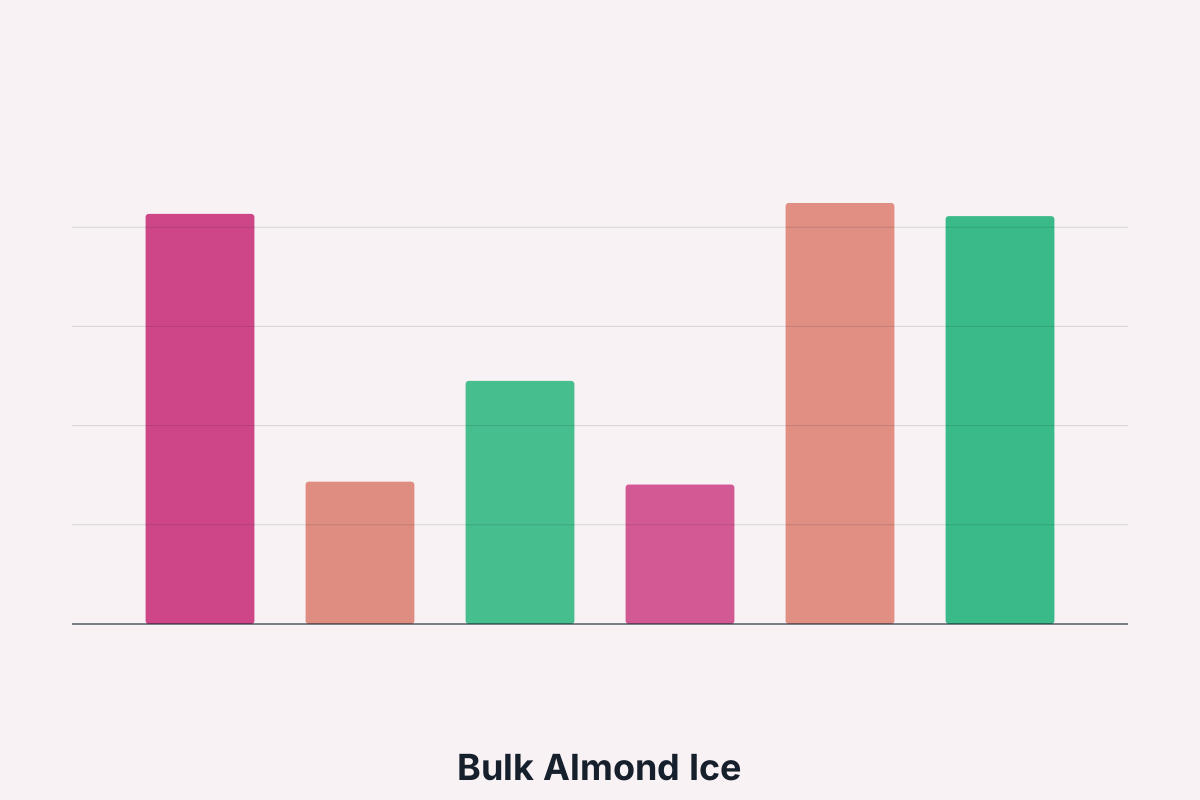
Indicative reference points for planning purposes: entry tier from USD 0.89 per unit at 2000 units, mid tier at USD 0.89, and volume tier at USD 1.34 for full container quantities. These figures move with specification, packaging and freight, so treat them as a shape rather than a quote.
How Almond Ice Batches Are Checked
Incoming inspection for almond ice is not about opening boxes at random. We weigh a sample of cartons, check batch codes against the production record, run a draw resistance measurement, and log the results so that a complaint three months later can be traced to a specific run.
Most defects in almond ice are not dramatic. They are loose tolerances, a slightly thin seal, a mouthpiece that clicks. Left alone they turn into leak complaints, which are the single most common reason a retailer drops a line.
- Keep sealed retained samples from every production batch.
- Check carton dimensions against your freight quote before confirming.
- Write the complaint threshold into the order terms.
- Ask how the factory measures puff count, then compare like with like.
- Confirm the current customs classification with your own broker.
Practical Checklist
- Keep sealed retained samples from every production batch.
- Model landed cost, not ex-works price, when comparing quotes.
- Agree the tolerance band in writing before approving artwork.
- Confirm the current customs classification with your own broker.
- Start with a mixed carton and let your own sell-through decide.
- Plan the switch from air to sea freight before you need it.
Frequently Asked Questions
What is the usual minimum order for almond ice?
For a standard production run the minimum is normally one master carton per flavour, though mixed cartons can be arranged for a first order. If you are testing the line, ask about a sample pack first and treat the freight as part of your research budget.
How long does a almond ice order take to arrive?
Production typically takes ten to eighteen working days after artwork approval, and transit depends on the method you choose. Air express is fastest, sea freight is cheapest at volume. We confirm both at quotation so there is no surprise later.
How should almond ice be stored?
Cool, dry and out of direct sunlight. Heat and light are the two things that shorten shelf life fastest. Rotate stock by batch code rather than by arrival date, and keep cartons off concrete floors in humid warehouses.
What if a batch does not match the sample?
Keep the retained samples from the approval stage. If a delivered batch measurably differs, we compare against the retained set and resolve it against the production record. This is why we insist on sealed retained units from every run.
Next Step
Questions that are not answered here are usually the interesting ones. Reach out with the specifics of your market and we will answer with numbers rather than adjectives.
Related Reading
- Almond Ice Counterfeit Risk and Serialisation — High Volume Buyers
- Almond Ice KPI Set for Wholesale Operations — Step by Step
- Almond Ice Airflow Design and Customer Perception — Entry-Level Price Points
- Almond Ice Warranty and After Sales: Setting Expectations — UK and Ireland
- Almond Ice Future Outlook: Trends Worth Watching — Mixed Cabinets
- Almond Ice Damage Claims and How to Avoid Them — Busy Buyers